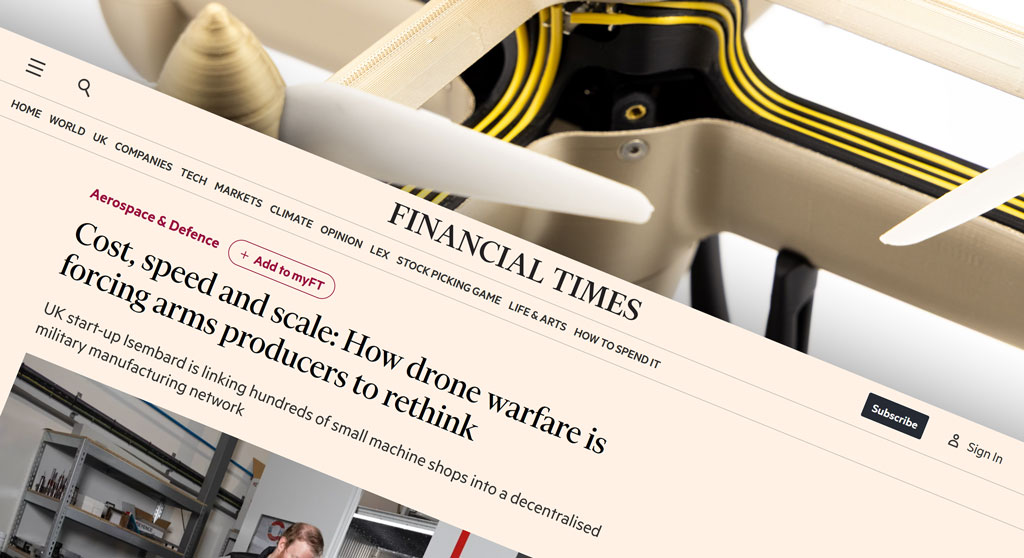
Financial Times 6th July 2026
Drone Warfare Is Reshaping Defence Manufacturing
The conflict in Ukraine has highlighted a major shift in modern warfare: success increasingly depends on the ability to produce large volumes of affordable, adaptable drones rather than a small number of highly sophisticated weapons systems.
For decades, defence industries focused on developing advanced fighter jets, missiles and warships designed to remain operational for many years. However, the rapid evolution of drone technology is forcing governments and manufacturers to rethink this model. Battlefield conditions now demand systems that can be redesigned, tested and produced in weeks rather than years.
A key focus is improving speed, scalability and cost efficiency. Manufacturers are looking to adopt approaches more commonly seen in commercial technology sectors, where products are updated frequently and supply chains are optimised for rapid production.
Automation is becoming a key part of the solution. UK company Q5D has developed robotic systems that automate the production of wiring harnesses, one of the most labour-intensive parts of drone manufacturing. The company claims its technology can reduce costs by up to 50% while doubling production speed and has secured a contract with the US Army as it seeks to dramatically increase drone output.

Automation equipment that transforms electrification, solves labour shortage & shortens supply chain
Another example is UK start-up Isembard, which is rethinking how military equipment is produced. Instead of relying on a handful of large defence contractors, the company operates a decentralised manufacturing network that connects hundreds of smaller machine shops through software. This approach enables factories to be established in months rather than years and allows production to scale far more quickly.
Across Europe and North America, defence technology companies are also embracing the use of commercially available components and flexible assembly processes to accelerate production. The goal is to create manufacturing systems that can quickly scale when demand increases while reducing dependence on overseas suppliers.
Military leaders are recognising that procurement practices must evolve alongside manufacturing capabilities. Traditional defence programmes often operate on timelines measured in decades, but the pace of drone warfare requires a much faster cycle of testing, learning, purchasing and deployment.
Despite growing investment and political support, challenges remain. Many drone manufacturers are struggling to expand production because large-scale government contracts have been slow to materialise. At the same time, there is concern that stockpiled drones can become obsolete quickly as battlefield technology continues to evolve at a rapid pace.
The overarching lesson from Ukraine is clear: industrial capacity has become a strategic asset. In future conflicts, the ability to manufacture large quantities of effective, low-cost systems quickly may be just as important as developing cutting-edge military technology.
Key takeaway: Defence manufacturing is moving away from a model centred on a few expensive platforms towards one focused on mass production, rapid innovation and operational flexibility. The organisations that can combine speed, scale and affordability will be best positioned to meet the demands of modern warfare.